← Back to dashboard
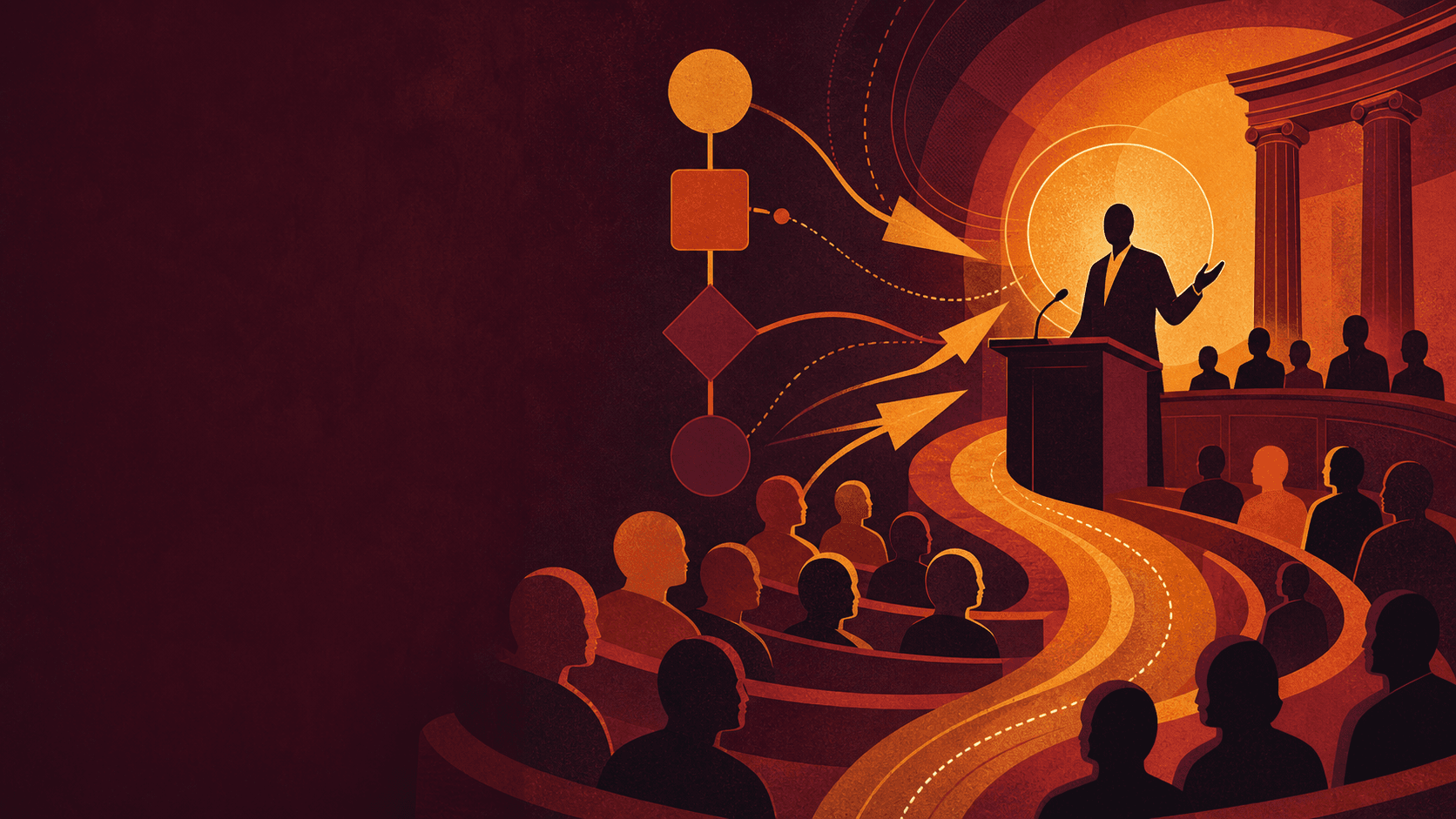
A civic room with a speaker, audience, arrows of attention, and visible rhetorical structure.

The Anatomy of Persuasion

Analyse persuasion as situated, inspectable action across audiences, purposes, frames, and media.

Learning goals

  • Analyse how rhetorical choices depend on audience, purpose, medium, timing, and constraints.
  • Distinguish the functions and evidential limits of ethos, logos, pathos, framing, concession, and rebuttal.
  • Adapt and revise an argument while preserving accuracy and making uncertainty visible.
  • Use AI for support, not finished answers.

Reading support

Answer a question to unlock the next source section. Options reshuffle after a wrong answer.

Guided reading mode is off for this student.

The Room You Are Trying to Move

Overview

Persuasion is often described as a collection of techniques. Yet a repeated phrase, an emotional story, or a confident voice has no fixed effect outside a situation. As you read, follow one proposal through several audiences and media. Notice how the argument changes, what remains constant, and where adaptation can become manipulation.

Read

The Room You Are Trying to Move

1. A speech with nowhere to land

Mara has three minutes to persuade a municipal committee to open an unused public building as an evening study and meeting space. She begins with the sentence she has rehearsed all week: “A town that closes doors on young people should not be surprised when they stop knocking.”

The line is polished. It contains contrast, rhythm, and a memorable image. Mara expects attention. Instead, one committee member studies the cost sheet. Another writes *Who supervises?* in the margin. A third looks towards the clock.

Mara has treated persuasion as something stored inside a sentence. The committee receives it as one move within a practical decision. They need to know what is being proposed, which problem it addresses, what it would require, and why this option deserves support. Her line may frame the issue, but it cannot carry the whole argument.

2. The rhetorical situation

After the meeting, Mara's mentor asks five questions: Who can act? Who will be affected? What decision is actually available? What constraints shape it? Why is this moment different from another?

The answers redraw the task. The committee can recommend a six-month pilot, not promise a permanent centre. Nearby residents will be affected by evening activity. The building already exists, but staffing and access remain unresolved. The proposal competes with other uses of limited public resources. A decision is approaching because the building's temporary lease is ending.

This network is the rhetorical situation. It includes speaker, audience, purpose, issue, medium, timing, and constraints. A persuasive choice works within that network. The same sentence can sound urgent in one room, vague in another, and insulting in a third.

3. Audience is not a stereotype

Mara first describes the committee as “older people who care only about money”. Her mentor objects. An audience analysis built from contempt will produce a brittle speech.

The committee is not one mind. One member wants an evaluable pilot. Another worries about excluding groups who need the building. A third supports youth provision but distrusts hidden operational costs. Their concerns are not identical or automatically hostile.

To analyse an audience is not to guess private beliefs from age, accent, job, or appearance. It is to identify roles, responsibilities, prior knowledge, likely questions, and the values made visible in the situation. Ethical adaptation responds to relevant differences. Stereotyping invents a convenient audience so that the speaker never has to listen.

4. Credibility as a relationship

Mara had planned to establish ethos by listing positions she holds. Credentials can matter, but credibility is not a medal a speaker pins on before entering the room. It is a judgement an audience forms through the relationship among the speaker's knowledge, conduct, evidence, and acknowledgement of limits.

In her revised opening, Mara states that she helped organise two trial study evenings in borrowed rooms. She explains what the volunteers could observe and what they could not. She names the unresolved supervision question before the committee raises it.

This admission does not weaken her automatically. It shows practical knowledge without pretending to complete authority. Her ethos develops through accuracy, fairness, and responsibility. A confident claim unsupported by the speaker's actual access may damage credibility; a precise limit may strengthen it.

5. Reasoning needs a visible bridge

Mara's argument includes several observations: students seek evening workspaces; the building is currently unused at those times; volunteers are willing to help; and committee members want public buildings to serve community needs. None of these points alone proves that the pilot should be approved.

The missing part is the bridge between evidence and conclusion. Mara makes it visible: if a bounded pilot can test demand and operation without committing the town permanently, then temporary use is a proportionate response to an identified need. The committee can now inspect the reasoning. It can challenge the need, the feasibility of the test, the meaning of “proportionate”, or the assumption that the proposed use is preferable to alternatives.

Logos is not a pile of facts. It is the structure that connects grounds, assumptions, qualifications, and claims. Making that structure visible gives an audience something more useful than certainty: it gives them an argument they can examine.

6. Feeling directs attention

At a residents' meeting, Mara tells a short story about arriving at the locked building on a rainy evening while several students wait under its wide entrance canopy. The image gives the proposal a human scale. It asks listeners to imagine unused shelter beside unmet need.

This is pathos, an appeal through feeling and value. Emotion is not the opposite of reason. Concern, hope, fear, pride, and anger help people recognise what may matter. The ethical question is what the feeling is being asked to do.

Mara's scene illustrates the need already named; it does not prove how common the need is or silence concerns about noise. If she selected an extreme story and presented it as typical, the emotional force would outrun its evidential role. Feeling can open attention. It should not close inquiry.

7. Frames include and exclude

The proposal can be called “opening a shared room” or “funding another youth facility”. Both descriptions point towards the same decision, but each frame selects a different foreground. The first emphasises access and common use. The second emphasises cost, category, and competition with existing services.

No account is entirely unframed. Speakers must choose names, boundaries, comparisons, and starting points. The responsibility is to notice what a frame makes prominent and what it pushes to the edge.

Mara keeps the phrase “shared room” but adds the questions her preferred frame might hide: Who controls access? Which groups receive priority? What costs continue even when the building is already present? By exposing these edges, she prevents an inviting metaphor from pretending to be a complete description.

8. Concession without surrender

A campaign volunteer wants Mara to dismiss the noise concern as an excuse. Mara instead begins her response: “Evening access could disturb nearby residents if closing times, entrances, and responsibility are unclear.”

A concession recognises a point that complicates the speaker's case. Used badly, it can be decorative: “Some people disagree, but they are mistaken.” Used well, it changes the proposal or the reasoning. Mara follows the concession with a conditional offer: a fixed closing time, one staffed entrance, a named contact, and a review point during the pilot.

She has not abandoned her position. She has shown that persuasion can be responsive rather than victorious. The concern becomes part of the design. Her rebuttal is stronger because it answers the most defensible version of the objection instead of attacking a weaker substitute.

9. The medium changes the argument

For a short campaign video, the volunteers want to cut together quick shots of locked doors, empty rooms, and impatient faces. The sequence is visually forceful, but it creates a simple story: officials keep people out while space is wasted.

A video favours compression, juxtaposition, voice, pace, and image. A committee document favours traceable detail. A live meeting allows questions and repair. The form changes which parts of the argument are easiest to see and which can disappear.

Mara keeps the locked-door image but includes the pilot's limits and the residents' concern in the narration. The video becomes less accusatory and more accurate. It may attract fewer instant reactions, yet it invites supporters into the real decision rather than a cleaner fictional conflict.

10. Moving a room without controlling it

At the next committee session, Mara's opening line returns: “A town that closes doors on young people should not be surprised when they stop knocking.” This time it is followed by a defined proposal, a reasoned bridge, practical limits, and a concession that has altered the plan.

The committee does not become a single persuaded body. Members ask harder questions. One proposes sharing the pilot with an adult language group. Another requests clearer evaluation criteria. The chair postpones the recommendation until revised costs are available.

Mara has not failed because immediate agreement is absent. Her rhetoric has moved the decision from a symbolic dispute towards an inspectable choice.

Responsible persuasion does not mean removing force from language. It means using force without hiding uncertainty, manufacturing an enemy, or treating attention as consent. The speaker tries to change what others can see, value, or decide. The audience retains the right to question the frame, test the reasoning, resist the appeal, and answer back.

> Keep this idea: Persuasion is a relationship among speaker, audience, purpose, evidence, language, medium, and situation. Its quality depends on what the audience is enabled to examine, not only on whether the speaker gets the desired result.
Exercises for this text

rhetorical analysisCore path

The anatomy of persuasion

Choose the strongest analysis, then identify the textual choice, audience effect, and evidential limit that support it.

  1. Why does Mara's polished opening fail to carry the committee's decision by itself?

    Choose one

  2. What makes the mentor's audience analysis more ethical than Mara's first description?

    Choose one

  3. How does Mara develop ethos in the revised opening?

    Choose one

  4. What is the visible bridge in Mara's logos?

    Choose one

Practice

Rhetorical situation and adaptation map

Map Mara's claim, audiences, purposes, evidence, constraints, medium, frame, and strongest objection. Adapt one part for a committee document and a short public video, then explain what must remain accurate in both versions.

Optional visual planning help

Word cloud

committeeversionagencyrhetoricalvisibleaudiencesituationconstraintsremainversionsargumentuncertaintypersuasiveclaim

Mind map

1. Claim

  • → This audience needs to decide ...
  • → The evidence supports ..., but not ...

2. Evidence

  • → Audience analysis uses roles and responsibilities, not identity guesses.
  • → The reasoning bridge is explicit.

3. Audience

  • → purpose
  • → recipient
  • → register

4. Revision

  • → The concession changes the proposal or claim.
  • → Both versions preserve material limits and agency.

Support path

Build a rhetorical situation map

What you are practising: analysing a rhetorical situation and adapting an argument while keeping evidence, agency, constraints, and uncertainty visible

Path focus: Use one fictional proposal and a provided speaker-audience-purpose grid.

What to do 1. Name the decision the audience must make. 2. List one relevant audience concern without stereotyping. 3. Connect one piece of evidence to a bounded claim. 4. Add one concession that changes the proposal.

Tiny model: Committee version: ‘A four-week pilot would test evening demand.’ Public-video version: ‘For four weeks, the building could stay open later while the committee measures use and noise.’ The trial and its limit remain visible in both.

AI boundary: AI may help you locate vague agency or compare two audience versions after you draft them. It must not invent evidence, impersonate an affected stakeholder, or produce the final persuasive text.

Sentence starters

  • This audience needs to decide ...
  • The evidence supports ..., but not ...
  • A serious objection is ...
  • I adapted ... because the medium makes ... easier to see.

Success checks

  • Audience analysis uses roles and responsibilities, not identity guesses.
  • The reasoning bridge is explicit.
  • The concession changes the proposal or claim.
  • Both versions preserve material limits and agency.

Core path

Adapt one argument across media

What you are practising: analysing a rhetorical situation and adapting an argument while keeping evidence, agency, constraints, and uncertainty visible

Path focus: Preserve claim, evidence, qualification, and responsibility in a committee document and public video.

What to do 1. Map speaker, audience, purpose, medium, timing, and constraints. 2. Identify the strongest objection and its evidence. 3. Write the committee version and the public version. 4. Annotate what changed and what had to remain accurate.

Tiny model: Committee version: ‘A four-week pilot would test evening demand.’ Public-video version: ‘For four weeks, the building could stay open later while the committee measures use and noise.’ The trial and its limit remain visible in both.

AI boundary: AI may help you locate vague agency or compare two audience versions after you draft them. It must not invent evidence, impersonate an affected stakeholder, or produce the final persuasive text.

Sentence starters

  • This audience needs to decide ...
  • The evidence supports ..., but not ...
  • A serious objection is ...
  • I adapted ... because the medium makes ... easier to see.

Success checks

  • Audience analysis uses roles and responsibilities, not identity guesses.
  • The reasoning bridge is explicit.
  • The concession changes the proposal or claim.
  • Both versions preserve material limits and agency.

Challenge path

Red-team responsible persuasion

What you are practising: analysing a rhetorical situation and adapting an argument while keeping evidence, agency, constraints, and uncertainty visible

Path focus: Test where persuasive efficiency begins to hide agency, alternatives, or uncertainty.

What to do 1. Draft two strategically different frames for the same proposal. 2. Mark what each frame foregrounds and excludes. 3. Red-team the stronger version for stereotype, straw person, hidden bridge, and decorative concession. 4. Revise and defend the remaining rhetorical choices.

Tiny model: Committee version: ‘A four-week pilot would test evening demand.’ Public-video version: ‘For four weeks, the building could stay open later while the committee measures use and noise.’ The trial and its limit remain visible in both.

AI boundary: AI may help you locate vague agency or compare two audience versions after you draft them. It must not invent evidence, impersonate an affected stakeholder, or produce the final persuasive text.

Sentence starters

  • This audience needs to decide ...
  • The evidence supports ..., but not ...
  • A serious objection is ...
  • I adapted ... because the medium makes ... easier to see.

Success checks

  • Audience analysis uses roles and responsibilities, not identity guesses.
  • The reasoning bridge is explicit.
  • The concession changes the proposal or claim.
  • Both versions preserve material limits and agency.

Task input field

Student draft space

Type your own draft here.

Writing and evidence assignments

A responsible persuasive proposal

Write a 700-900-word persuasive proposal for a fictional public decision. Define the rhetorical situation, show the inferential bridge, address a strong objection through concession, and add a revision note explaining which audience or medium constraint shaped your choices.

Optional visual planning help

Word cloud

persuasiveproposalaudienceproduceresponsiblepublicrevisionfictionaldecisionmediumshapedversionsdocumentconstraints

Mind map

1. Claim

  • → What exact decision should the audience make?
  • → Which grounds support the claim, and what assumption connects them?

2. Evidence

  • → The proposal is decision-ready and bounded.
  • → Ethos, logos, pathos, and framing are analysed by function.

3. Audience

  • → purpose
  • → recipient
  • → register

4. Revision

  • → The rebuttal addresses the objection’s strongest form.
  • → The revision note explains a substantive change.

Support path

Guided persuasive proposal

Goal: Produce a responsible persuasive proposal for a fictional public decision and document how audience or medium constraints shaped revision.

Path focus: Use a decision-ready structure with a claim, evidence bridge, concession, and bounded action.

AI boundary: AI may help you locate vague agency or compare two audience versions after you draft them. It must not invent evidence, impersonate an affected stakeholder, or produce the final persuasive text.

Planning questions

  • What exact decision should the audience make?
  • Which grounds support the claim, and what assumption connects them?
  • What is the strongest defensible objection?
  • How will the proposal change in response?
  • Which limit must survive every adaptation?

Success checks

  • The proposal is decision-ready and bounded.
  • Ethos, logos, pathos, and framing are analysed by function.
  • The rebuttal addresses the objection’s strongest form.
  • The revision note explains a substantive change.

Core path

Responsible public proposal

Goal: Produce a responsible persuasive proposal for a fictional public decision and document how audience or medium constraints shaped revision.

Path focus: Develop a 700–900-word argument with a full rhetorical situation and revision note.

AI boundary: AI may help you locate vague agency or compare two audience versions after you draft them. It must not invent evidence, impersonate an affected stakeholder, or produce the final persuasive text.

Planning questions

  • What exact decision should the audience make?
  • Which grounds support the claim, and what assumption connects them?
  • What is the strongest defensible objection?
  • How will the proposal change in response?
  • Which limit must survive every adaptation?

Success checks

  • The proposal is decision-ready and bounded.
  • Ethos, logos, pathos, and framing are analysed by function.
  • The rebuttal addresses the objection’s strongest form.
  • The revision note explains a substantive change.

Challenge path

Multi-audience persuasion portfolio

Goal: Produce a responsible persuasive proposal for a fictional public decision and document how audience or medium constraints shaped revision.

Path focus: Create two genre versions and evaluate the ethical cost of each adaptation.

AI boundary: AI may help you locate vague agency or compare two audience versions after you draft them. It must not invent evidence, impersonate an affected stakeholder, or produce the final persuasive text.

Planning questions

  • What exact decision should the audience make?
  • Which grounds support the claim, and what assumption connects them?
  • What is the strongest defensible objection?
  • How will the proposal change in response?
  • Which limit must survive every adaptation?

Success checks

  • The proposal is decision-ready and bounded.
  • Ethos, logos, pathos, and framing are analysed by function.
  • The rebuttal addresses the objection’s strongest form.
  • The revision note explains a substantive change.

Evidence assignment input field

Student draft space

Type your own draft here.